
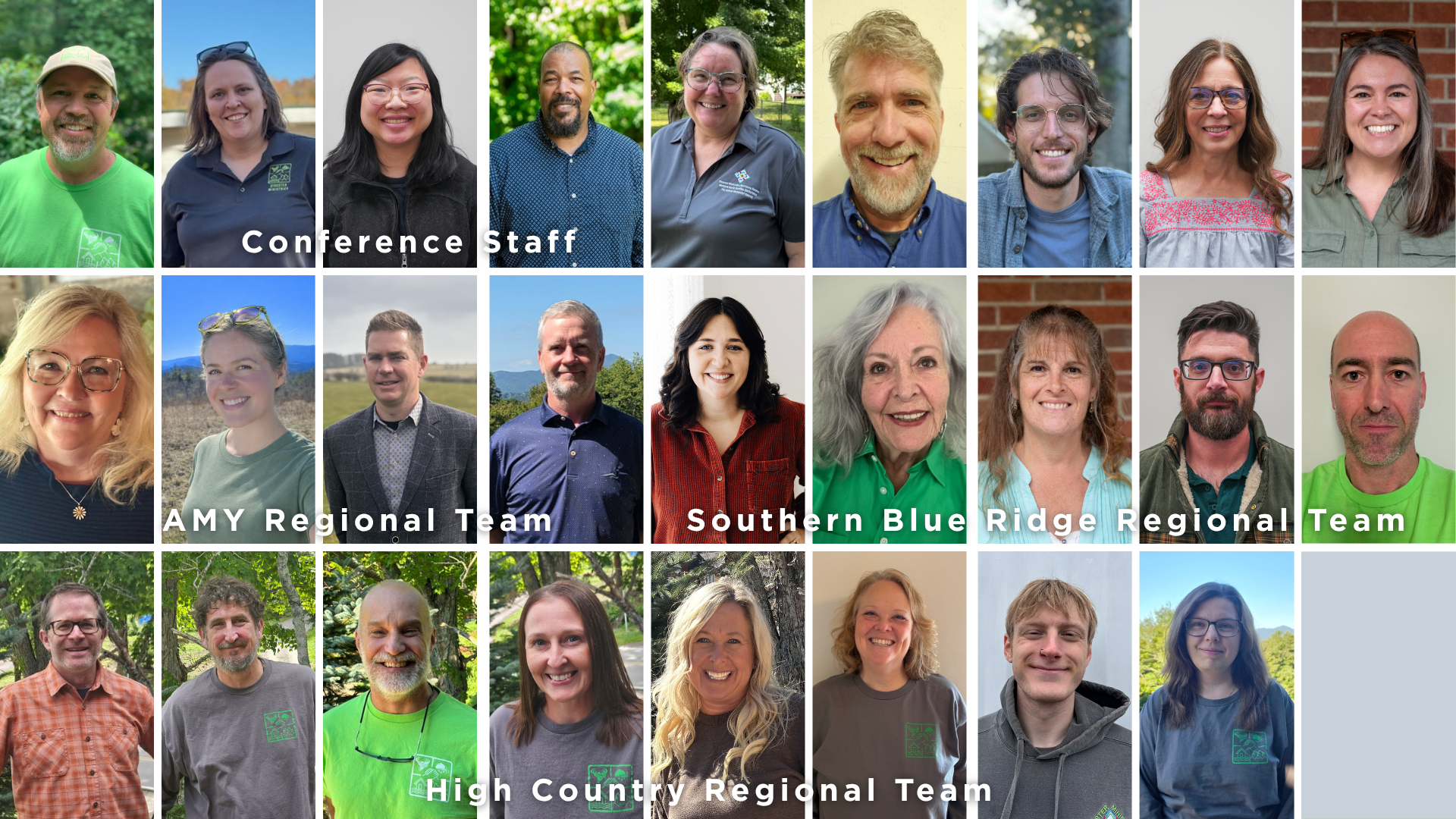
As Director of Recovery for the Conference’s Disaster Ministries office, Maggie Armstrong leads a 25-person staff stationed from Huntersville to the High Country. Team members care deeply about the ministry. They draw from decades of experience. And they don’t always see things the same way.
When disagreements occur, it’s not necessarily because anyone is doing a poor job. More often, friction emerges from the unique blend of perspectives and personality types on the team.
For Maggie, that made training in facilitation particularly relevant.
“The tools from this training enable me to create spaces for staff members to share their own wisdom, and to hear and respect the wisdom of other people on their staff,” she said.
Maggie started the job a month after Helene leveled parts of Western North Carolina. As the daughter of UMC pastors Jamie Armstrong and the late Elizabeth Graves, she was already well versed in the ways of United Methodism.
Helene’s devastation, by contrast, exceeded the limits of human understanding. Two years after the storm, Disaster Ministries remains engaged in long-term recovery efforts. The team operates three regional hubs comprised of case managers and construction coordinators.
Part of the Foundation’s $250,000 contribution toward Helene recovery enabled Maggie to receive training in Technology of Participation (ToP) group facilitation methods. Pioneered in the 1950s and 60s, ToP has been used in 50 countries and hundreds of organizational, community, and corporate change initiatives.
Maggie gained far more than she expected – a new way of understanding her own role as a leader.
Learning to make space for wisdom
Maggie assumed that a manager who convenes a meeting should do most of the talking. The training challenged that assumption.
A facilitator can often add the greatest value by drawing wisdom out of other people in the room. That shift is especially significant to Maggie’s role overseeing three regional teams, each with its own Team Lead.
ToP methods emphasize open, honest dialogue and inclusion of all voices: When people know their responses will be accepted like everybody else’s, they feel free to say what they really think. There is greater ownership in a collectively agreed upon decision.
“Acting as an instrument of facilitation allows me to be present and helpful, while also allowing the Team Leads to share in a way that shapes the conversation,” she said.
Maggie did not have to wait long to put what she learned into practice.
From “come to Jesus” to consensus
Just a few days after the training, Maggie met with a Regional Team Lead who was struggling to build cohesion on her team. The group cared deeply about its work, but had different opinions on how to do things. The Team Lead decided it was time for a “come to Jesus” meeting.
The questions were daunting: How can I help the team understand this? What can we do to get on the same page?
Suddenly, the answer became clear. Maggie reached into her backpack for a training manual and began designing a ToP Consensus Building Workshop.
What began as a management challenge became an opportunity to make lasting change.
Hearing wisdom in one another
The team used the ToP consensus building process to define goals both practical and relational.
The rational (practical) aim was to agree on next steps and reasonable expectations. The experiential (relational) aim was equally important: listen to one another, build trust, and move from a “fight or flight” mindset to solving problems together.
Perhaps the most meaningful breakthrough did not involve any particular decision. During the workshop, Maggie carved out space for internal and external processors, those who are hesitant to share ideas up front and those eager to speak at the first available moment. The louder voices began echoing ideas offered by the quiet observers.
Team members were relieved. It turns out their colleagues had been thinking and feeling many of the same things. The process revealed concerns, ideas, and values that had previously gone unspoken.
Maggie describes the result simply: “It helped them move forward as a more cohesive team.”
One person’s professional development may not seem like a game changer. But Maggie now has a set of practices she can infuse into the work of regional teams and administrative staff. For Disaster Ministries, healthy communication has a direct impact on the ability to do God’s work.
Maggie received so much more than training. She discovered a better way to lead.
This story was written by Shonnie Streder, pastor of Bright Hope Laurel UMC in Madison County, owner of REV Strategic Consulting, and a Certified ToP Trainer. Contact Shonnie here to learn more about tools for collaborative facilitation.
United Methodists work to preserve legal aid for immigrants
The roots of this effort go back to February when members of the WNCC’s Blue Ridge District traveled to Washington, D.C. for a march against immigration injustice. Four months later, the group turned its message into action.
Foundation will host workshop for clergy, lay persons
The Foundation will host a workshop on Stewardship in the Black Church led by Rev. Melvin Amerson, a nationally recognized speaker and author of numerous books on faith and generosity.
These students will enrich our churches and communities
These students are pursuing their dreams with support from scholarships managed and awarded by the Foundation.


